Is your operation able to spot delivery confirmations logged outside the delivery area?
In day-to-day logistics, every minute counts. Few situations are as costly as a delivery confirmation (proof of delivery, POD) recorded away from the correct destination. When the confirmation is logged far from the drop-off point, a domino effect begins: rework, re-deliveries, higher cost per order, customer complaints, and audit risks. The good news: there’s accessible technology to detect and act on these cases in real time—without adding friction for field teams.
In this article, you’ll understand why the problem happens, which indicators to track, and how Meu Rastreio’s Route Alerts help ensure the confirmation happens in the right place, with reliable evidence and automatic notifications to operations.
Why out-of-area confirmations happen
Even mature operations face this challenge due to a combination of factors:
- Pressure to meet delivery windows (SLA) and dense routes.
- Parking or access difficulties at complex addresses (condos, malls, business centers).
- Inaccurate addresses or unclear numbering.
- Communication gaps with the recipient at the time of delivery.
- Human error or, in some cases, attempts to conceal a missed delivery.
The impacts add up:
- Re-deliveries and extra pickups, raising cost per order.
- More complaints, refunds, and chargebacks.
- Lower NPS and brand reputation.
- Loss of operational visibility and harder audits.
- Misalignment between TMS/route plan and what actually happened on the street.
What changes when you validate confirmations by location
The key is to validate the driver’s position at the moment of confirmation by matching latitude/longitude to a configurable geofence (radius) for each destination. Combined with real-time alerts, your operation can:
- Block or flag the confirmation when it’s outside the allowed radius.
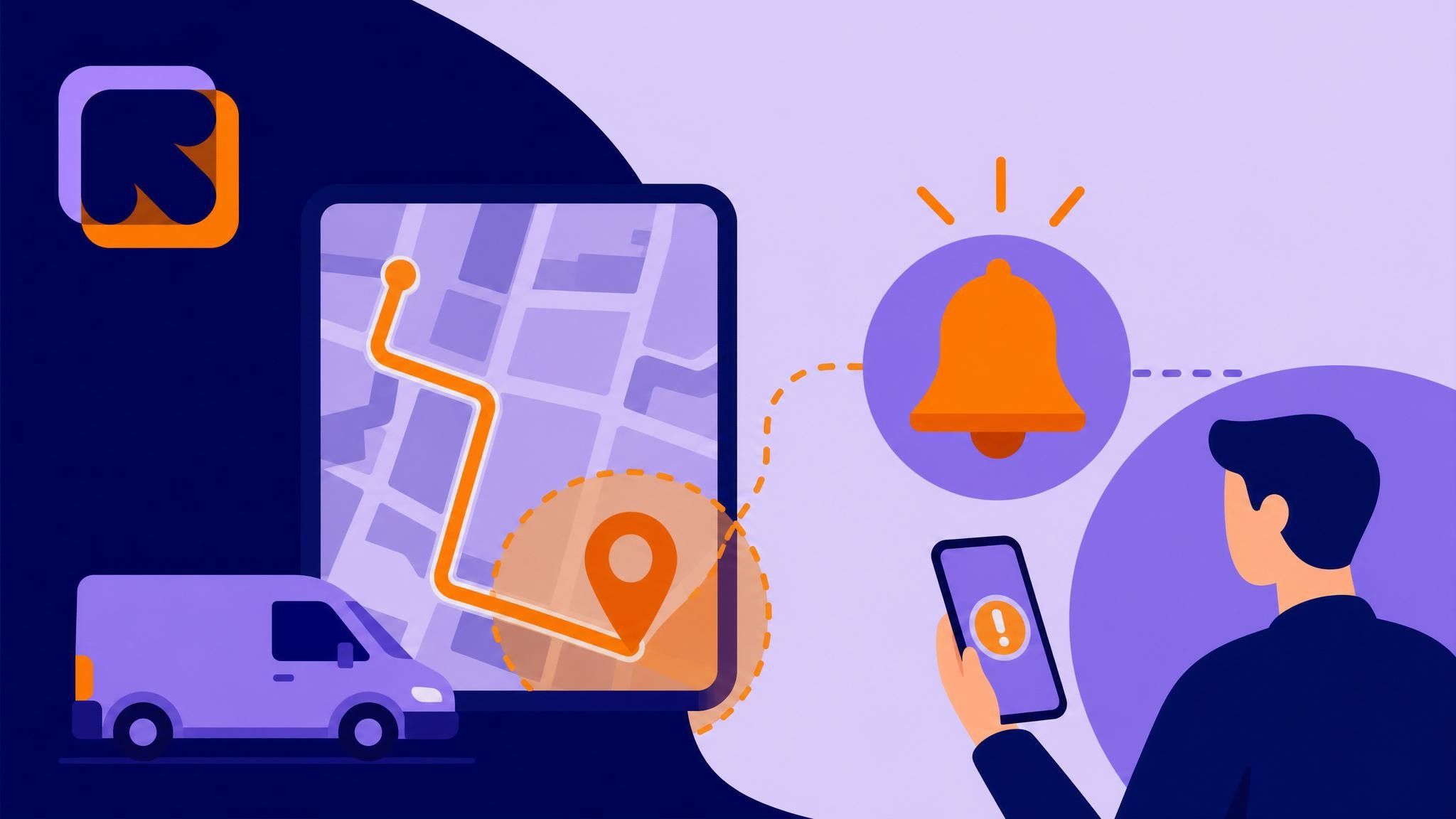
- Notify a supervisor immediately to intervene before the vehicle leaves the area.
- Collect proof of delivery (photo, signature, timestamp, and coordinates) with geospatial backing.
- Log the full exception history for audits and continuous improvement.
Meu Rastreio Route Alerts: proactive detection and action in minutes
Meu Rastreio’s Route Alerts were designed to give visibility and control over critical operational events—including confirmations logged outside the delivery area. With simple configuration, you turn an invisible risk into a predictable, measurable process.
How it works in practice
- Intelligent geofencing: set a tolerance radius by customer, delivery type, or region (e.g., 50 m in urban areas, 120 m in industrial zones).
- On-confirmation validation: when the delivery is marked as completed, the system checks the device’s position. If it’s outside the radius, it flags and applies your rule (alert, block, or request additional evidence).
- Real-time alerts: notifications to configurable channels (e.g., monitoring dashboard, email, internal app), with priority and action playbooks.
- Qualified proof of delivery: photos, signatures, and custom fields with timestamp and geolocation.
- Exception dashboard: reports by route, driver, customer, and time window to spot patterns and address root causes.
- Integrates with your workflow: compatible with routing, customer service, and audit processes, keeping a single source of truth.
Rules and tolerances tailored to your reality
Every operation is unique. Meu Rastreio lets you calibrate system behavior to fit your context:
- Delivery windows and radius by address profile.
- Exceptions for restricted-access areas (gates, docks).
- Mandatory photo or recipient contact when the confirmation happens near the geofence boundary.
- Escalation by level (operator, coordinator, manager) if the exception isn’t resolved within X minutes.
Practical, measurable benefits
By detecting and handling out-of-area confirmations in real time, operations typically see immediate gains:
- Fewer re-deliveries and returns.
- Lower cost per delivery and smarter future routing.
- Higher first-attempt SLA.
- Fewer “order not received” complaints and refunds.
- More confidence for field teams, with less ambiguity and rework.
- Stronger foundation for audit and compliance, with lower operational risk.
Beyond direct gains, there are indirect positives: improved driver training, better address data quality, and more accurate route planning.
Hypothetical examples
- Regional B2B distributor: after applying an 80 m geofence in central areas, the “out-of-area confirmation” rate fell from 3% to 0.7% in eight weeks. Related re-deliveries dropped at a similar pace, freeing fleet windows to increase daily volume without adding capacity.
- Metropolitan e-commerce: with a 50 m radius and a photo requirement for confirmations above 40 m from the point, operations began acting within 5 minutes of the alert. First-attempt SLA rose and “didn’t receive it” contacts to customer service dropped visibly.
- Industrial deliveries to logistics condos: by allowing parameterized exceptions for docks and gates, the operation preserved quality control without penalizing legitimate scenarios where confirmation occurs at the guardhouse.
Note: the figures above are illustrative, showing how rule design can impact key indicators.
Which metrics to track
To measure the effectiveness of out-of-area control, monitor:
- Rate of confirmations outside the geofence by route, region, and driver.
- Average distance between confirmation point and destination.
- Time-to-response after the alert.
- Re-deliveries tied to confirmation inconsistencies.
- Customer service complaints and chargebacks for “order not received.”
- First-attempt SLA and daily success rate.
With Meu Rastreio’s exception dashboard, you can combine these metrics to decide where to adjust radius settings, train teams, or fine-tune delivery windows.
Best practices for fine-tuning
- Start with conservative radii and adjust by region: dense areas need tighter tolerances; rural areas, wider.
- Strengthen address data: reference points, coordinates, and access instructions reduce out-of-area attempts.
- Standardize evidence: define when photo and signature are mandatory and how they must be captured.
- Train and engage teams: explain why validation exists and how it protects route performance and customer trust.
- Use exception analytics: focus on outliers and recurring patterns by time window, ZIP code, or customer.
Trends and privacy considerations
Geofencing and confirmation validation have become standard in last mile and B2B. At the same time, it’s essential to respect data protection laws:
- Collect and process only what’s necessary for the operational purpose.
- Inform and train employees about location use.
- Define data retention and access policies.
- Maintain audit trails and permission controls.
Meu Rastreio supports strong data governance practices and offers resources to configure your operation with security and transparency.
Get started in a few steps
- Map your most critical delivery points (high re-delivery or complaint incidence).
- Set initial tolerance radii by address profile.
- Establish a simple alert response protocol (who acts, within what time, which evidence to request).
- Track metrics for 2–4 weeks and adjust rules based on learnings.
- Expand to the entire operation once indicators stabilize.
With Meu Rastreio Route Alerts, this process is guided and measurable from day one.
Conclusion: total control over confirmation, in the right place
Catching confirmations logged outside the delivery area isn’t just another control layer—it’s a competitive edge that cuts costs, protects your SLA, and elevates the customer experience. By combining geofencing, real-time alerts, and qualified proof of delivery, your operation gains predictability and response speed—two currencies that matter in modern logistics.
Want to see how Meu Rastreio can detect and handle out-of-area confirmations in real time? Book a free demo with our specialists and turn exceptions into operational efficiency: https://www.meurastreio.app/pt-BR/alertas-rota