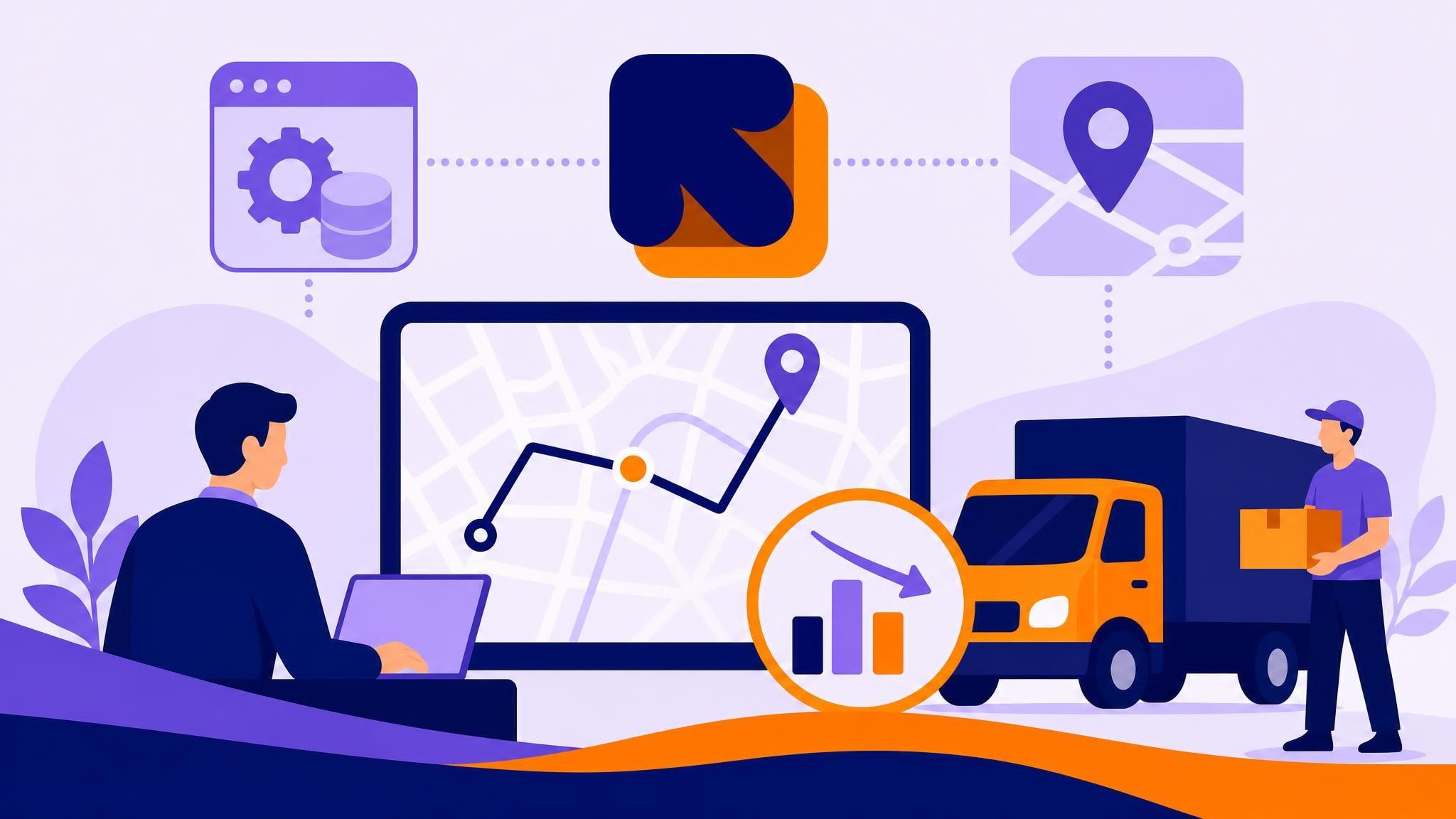

Logistics has never been under more pressure. Expensive fuel, tighter delivery windows, low operational visibility, and administrative rework drive up cost per mile and eat away margins. The good news: integrating your Omie ERP with Meu Rastreio turns scattered data into smart decisions—automating from order to proof of delivery—and consistently reducing transportation costs.
In this article, you’ll see how the Omie + Meu Rastreio combination helps fleet, operations, and finance leaders eliminate waste, boost efficiency, and accelerate invoicing without losing control.
Where your money is “leaking” in transportation
- Fuel and inefficient routes: poor planning, missed delivery windows, and avoidable traffic add miles and time on the road.
- Low load factor: trucks leaving underutilized or without consolidated orders increase cost per delivery.
- Corrective maintenance: breakdowns due to missing preventive maintenance cause unplanned downtime and higher emergency service costs.
- Redeliveries and returns: recipient not available, bad addresses, and poor communication inflate operating costs.
- Fines and aggressive driving: harsh acceleration and speeding raise fuel consumption and infraction risk.
- Manual financial management: spreadsheets, double entry, and slow reconciliations delay invoicing and introduce errors in freight and reimbursements.
How the Omie + Meu Rastreio integration reduces costs end to end
- From order to delivery with zero retyping
- Sales orders, invoices, and customer data flow from Omie and automatically become delivery orders in Meu Rastreio.
- Real-time status, events, and Proof of Delivery (POD) sync back to Omie, attached to the order/invoice.
- Costs and results by cost center, branch, or route stay centralized in Omie, simplifying P&L and cash forecasting. Result: fewer keystrokes, fewer errors, and a shorter invoicing cycle.
- Smart route optimization that cuts miles
- Consolidation of stops by region, delivery window, and priority.
- Route optimization with operational constraints (vehicle capacity, schedules, risk areas).
- Load balancing and visit sequencing to reduce empty miles. In practice, you drive fewer miles to deliver more—cutting fuel consumption and overtime.
- Proactive recipient communication
- Automatic ETA notifications and live status updates.
- Delivery window confirmation to reduce “recipient unavailable.”
- Fewer redeliveries with clear information and recorded attempts. Fewer redeliveries mean lower cost, less team strain, and faster cash collection.
- Digital proof of delivery and audit trail
- POD with photos, digital signature, and geolocation via the driver app.
- Standardized event logging (damage, shortage, refusal, no-show).
- Freight and service audits based on evidence, avoiding unjustified charges and speeding approvals in Omie. Beyond reducing disputes, you gain backing for billing and reliable delivery quality KPIs.
- Preventive maintenance and operational checklists
- Odometer control and time/usage alerts for preventive service.
- Departure/arrival checklists, tires, safety items, and damage.
- Centralized maintenance history to analyze cost per vehicle. On-time maintenance prevents downtime and supports smarter fleet renewal decisions.
- Eco-driving and compliance
- Real-time coaching for safe, fuel-efficient driving.
- Route and stop policies to reduce risk and off-route deviations.
- Driver- or team-level indicators for incentive programs. Safer, more consistent behavior directly lowers fuel, fines, and incident/claims rates.
- Integrated finance: from freight to P&L
- Freight tables and accessorials configured (detention/wait time, reconsignment, dimensional weight/cube) with SLAs.
- Automatic freight calculation and seamless Accounts Receivable and Payable integration in Omie.
- Faster reconciliation thanks to the link between order, delivery, and fiscal documentation. You invoice faster, safely advance receivables, and forecast cash flow on solid ground.
Tangible, measurable benefits
Companies that integrate Omie and Meu Rastreio typically report:
- Lower cost per mile and per delivery via route optimization, consolidation, and eco-driving.
- Fewer redeliveries and returns with proactive communication and digital POD.
- Less overtime and better shift utilization.
- Faster invoicing and lower delinquency, enabled by trustworthy POD.
- Data-driven decisions: OTIF, cost per order, load factor, redelivery rate, and delivery lead time by route. Results vary by operation, but one constant emerges—predictability: tighter control over time, costs, and quality.
Three practical scenarios
Regional distributor (B2B)
- Situation: multiple delivery windows and slow invoicing due to missing evidence.
- Action: Omie orders become optimized routes in Meu Rastreio; POD with photos and signature syncs back to ERP.
- Typical result: fewer miles driven through stop consolidation and same-day invoicing after delivery.
Last-mile e-commerce (B2C)
- Situation: high redelivery rate and complaints from lack of ETA visibility.
- Action: automated ETA messages to the consumer and window confirmation; standardized event logging in the app.
- Typical result: fewer redeliveries and higher NPS, with direct impact on cost per order.
Third-party logistics (3PL)
- Situation: disputes over accessorials and audit challenges.
- Action: parameterized freight and SLA rules; attachments (POD, photos) linked in Omie for faster approval.
- Typical result: fewer chargebacks/short-pays and a shorter collections cycle.
Must-have KPIs
Track these in a single view:
- Cost per mile, per order, and per route
- Load factor by vehicle
- OTIF (On Time In Full) and delivery lead time
- Redelivery rate and root causes
- Average fuel consumption and maintenance cost per vehicle
- Order cycle time (order → delivery → invoicing) These metrics fuel realistic targets and continuous improvement programs.
How to implement in 6 steps
-
Diagnosis and goals Map current processes, costs, and bottlenecks. Set clear targets (e.g., reduce CPM by X%, redeliveries by Y%).
-
Integration setup Connect Omie and Meu Rastreio. Validate customer, address, product, and cost center records.
-
Operational parameters Configure routing rules, delivery windows, capacities, and calendar. Define checklists and standard events.
-
Financial rules Implement freight tables, accessorials, and commercial terms. Tie orders/deliveries to accounts in Omie.
-
Training and pilot Enable planners/dispatchers, drivers, and finance. Run a controlled pilot to fine-tune routes and rules.
-
Scale and continuous improvement Monitor KPIs in dashboards, run PDCA (Plan-Do-Check-Act), and refine routes, freight policies, and maintenance based on data.
Trends that amplify cost reduction
- AI-assisted routing using historical traffic data
- Operational sustainability (fewer miles, fewer emissions, more savings)
- Robust digital evidence (multimedia POD) reducing disputes
- Deep fiscal and financial integration for faster, more reliable close
- Data-driven culture: decisions anchored in indicators, not assumptions
Why Omie + Meu Rastreio
- Native, logistics-focused integration: less rework and consistent data.
- End-to-end visibility: from order to verified delivery.
- Faster finance in Omie: freight, accessorials, and attachments integrated.
- Lean execution in Meu Rastreio: routing, tracking, and POD without friction.
- Scalable: from owned fleets to hybrid models with third parties.
Conclusion: total control to spend less and deliver more
Cutting transportation costs isn’t about blanket cuts—it’s about orchestrating people, process, and technology to drive fewer miles, boost capacity utilization, avoid rework, and invoice faster. The Omie and Meu Rastreio integration delivers exactly that: visibility, automation, and trustworthy data for decisions that pay back quickly.
Ready to transform your operation? Book a free demo and see how Omie + Meu Rastreio can reduce your logistics costs and accelerate results in practice.