When shipping costs spiral, e-commerce margins suffer. Unnecessary miles, re-deliveries, delays, and overtime erode profitability. In Magento 2 operations—where product mix and delivery promises vary—efficient routing is the difference between healthy growth and scaled losses. The good news: with the right data, logistics rules, and technology, you can measurably cut transportation costs without sacrificing customer experience.
In this article, you’ll see how Magento 2 stores use smart routing and real-time tracking to reduce expenses, boost first-attempt delivery rates, and turn the last mile into a competitive edge—and how Meu Rastreio’s Magento 2 integration powers those results.
Why shipping gets expensive in Magento 2 e-commerce
- Geographically dispersed orders and seasonal peaks that unbalance the fleet
- Tight delivery windows and strict SLAs (B2C and B2B) that demand precise planning
- Limited field visibility leading to route deviations and delays
- Re-deliveries due to recipient no-shows or incomplete addresses
- Manual planning (spreadsheets) that doesn’t scale and ignores real constraints
- Rising costs of fuel, tolls, and maintenance
Without solid routing, your team drives more, delivers less, and pays for the gap.
What smart routing is—and how it works Smart routing uses algorithms to build optimal routes while honoring operational constraints and service-level goals. Instead of “drawing by eye,” the system considers:
- Prioritization by SLA, urgency, and delivery window
- Fleet capacity (weight, cube, number of stops)
- Traffic restrictions, tolls, and vehicle-restricted zones
- Consolidation by region, ZIP code, product type, and load compatibility
- Service time per stop and driver shift limits
- Starting points (DC, dark store, or hub) and return paths
The result: fewer miles driven, higher vehicle utilization, and more first-pass deliveries.
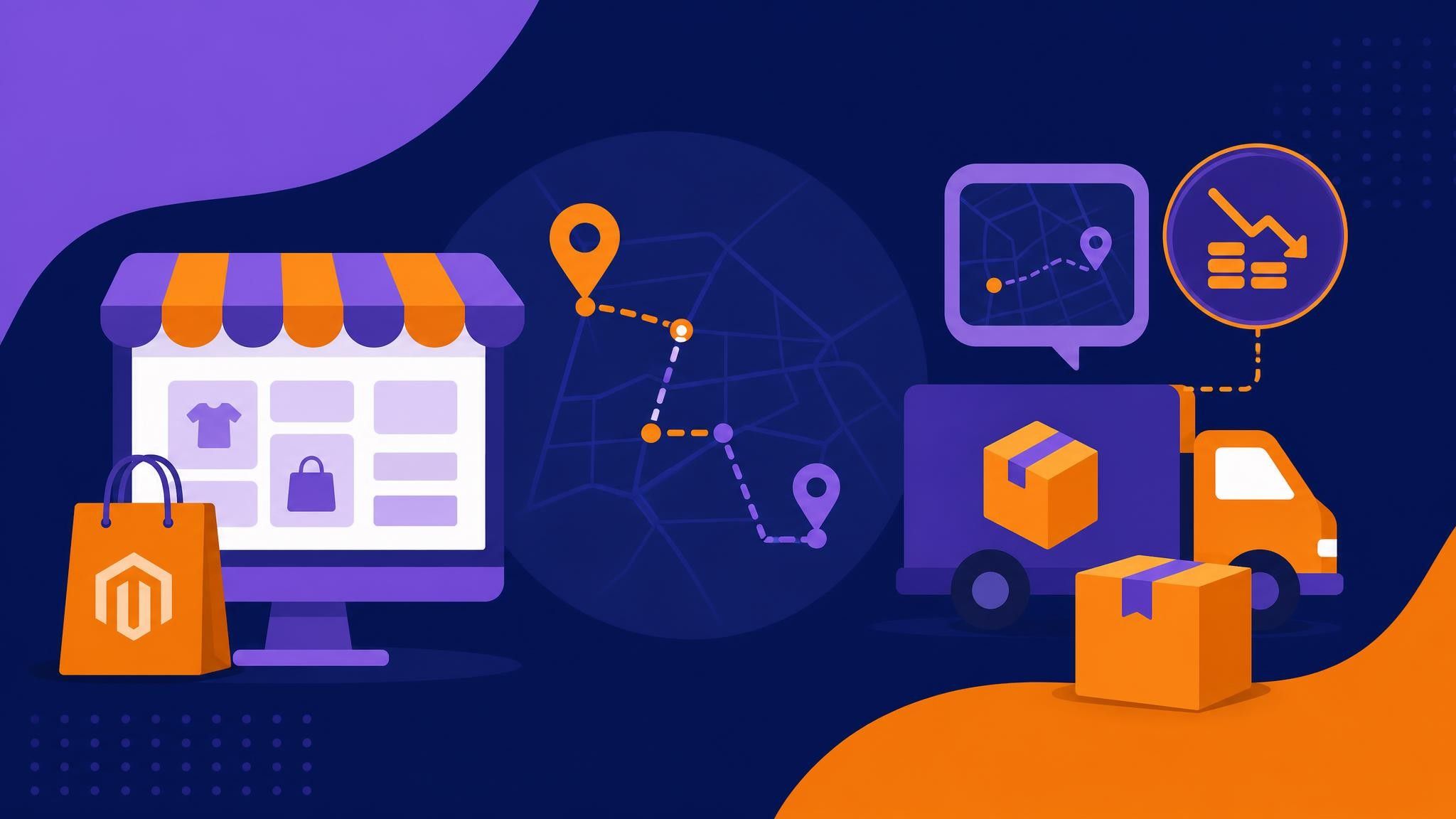
How the Meu Rastreio + Magento 2 integration reduces costs A direct integration between Magento 2 and Meu Rastreio turns orders into optimized routes, enables real-time execution monitoring, and delivers trustworthy KPIs for continuous improvement.
- Automatic import and intelligent grouping
- Magento 2 orders flow automatically into the logistics console with validated, geocoded addresses.
- Grouping by region, ZIP code, or delivery window reduces travel and idle time.
- Your e-commerce freight rules carry into planning to protect negotiated margins.
- Route optimization by fleet, SLAs, and time windows
- Algorithms optimize routes considering capacity, service time, and priorities.
- Load balancing across vehicles prevents overloading one driver while another is idle.
- What-if simulations let you compare cost scenarios (fuel, tolls, overtime) before go-live.
- Real-time tracking and dynamic re-routing
- Live map monitoring shows deviations, stops, and estimated arrival times (ETAs).
- If an order cancels or an incident happens, plans are recalculated to absorb impact at the lowest cost.
- Automated alerts anticipate delays and help protect your delivery SLA.
- Proactive customer communication
- Status notifications and ETAs reduce recipient no-shows.
- Self-serve tracking portals lower support contacts and lift NPS.
- Tighter delivery windows mean fewer re-deliveries—and lower costs.
- Digital proof of delivery and freight audit
- Photo, signature, and geolocation provide proof of delivery and reduce disputes.
- Audits of executed vs. planned routes surface waste (e.g., detours, excessive stops).
- KPIs such as cost per delivery, cost per mile, and first-attempt rate guide decisions.
Explore the integration: https://www.meurastreio.app/pt-BR/integracoes/magento-2
Tangible, measurable benefits Teams that shift from manual planning to smart routing with tracking commonly see:
- 10–30% fewer miles driven
- 8–20% fuel savings
- 15–35% fewer re-deliveries
- 10–25% less driver overtime
- 5–15% more deliveries per vehicle per day
- Fewer support contacts for delivery status and higher NPS
Percentages vary by order mix, geography, and fleet, but the direction is consistent: lower cost per delivery, more predictability, and scalable execution.
Real-world Magento 2 examples Fashion & accessories (B2C, city + metro area)
- Situation: 220 orders/day, wide delivery windows, and high first-attempt failures.
- Action: Zoning by ZIP code, refined windows by neighborhood, and SMS ETA notifications.
- Result after 90 days: 26% fewer miles, 31% fewer re-deliveries, and an 18% faster average delivery cycle.
Cosmetics (dark stores + ship-from-store)
- Situation: Multiple origins (2 DCs + 5 stores) and high costs due to duplicated routes.
- Action: Multi-origin optimization with allocation to the nearest node and micro-region consolidation.
- Result after 60 days: Cost per delivery down 22%, average vehicle utilization up 14%, next-day SLA above 95%.
Auto parts (B2B with scheduled deliveries)
- Situation: Customers with fixed windows and unloading constraints; delays triggered penalties.
- Action: Strict time-window adherence, service time per customer, and re-routing when service exceeded plan.
- Result after 45 days: Overtime down 19%, late-penalty fees down 40%, first-attempt rate up 12 pp.
Best practices to start saving with routing
- Standardize addresses and ZIP codes: validate and geocode before dispatch.
- Set clear policies: delivery windows, priorities, driver shift limits, and consolidation criteria.
- Classify your fleet: capacity (weight/cube), access restrictions, and per-mile/hour costs.
- Define metrics: miles per delivery, cost per stop, first-attempt rate, lead time, and NPS.
- Enable the field team: driver app usage, proof of delivery, and customer-contact best practices.
- Use simulations: test peak scenarios, new regions, and SLA changes without impacting live ops.
- Close the loop with data: compare planned vs. actual and tune rules weekly.
Trends shaping cost and strategy
- Faster last mile: same-day promises demand dynamic routing and multiple delivery windows.
- ESG and sustainability: fewer miles and re-deliveries cut emissions—operational and brand upside.
- Hybrid delivery: blending owned fleet, contracted carriers, and crowd-sourced delivery optimizes cost by route profile.
- Data as advantage: teams that measure and review KPIs weekly compound efficiency.
- End-to-end integration: Magento 2 connected to TMS/WMS and tracking closes information gaps and removes rework.
Why Meu Rastreio stands out for Magento 2
- Native Magento 2 connection: orders flow automatically into routing.
- SLA- and capacity-centric planning with cost simulations.
- Real-time tracking, customer communications, and digital proof of delivery.
- Performance dashboards with action-ready logistics KPIs.
- Guided onboarding and expert support for operations teams.
Conclusion: route better, spend less, deliver more Magento 2 merchants that adopt smart routing gain predictability, cut logistics costs, and improve customer satisfaction. With Meu Rastreio’s integration, you connect your e-commerce to delivery planning and execution—from order to proof of delivery—creating a data-driven cycle of continuous improvement.
Ready to see it in action? Book a free demo and discover how much you can save with the Meu Rastreio + Magento 2 integration: https://www.meurastreio.app/pt-BR/integracoes/magento-2