
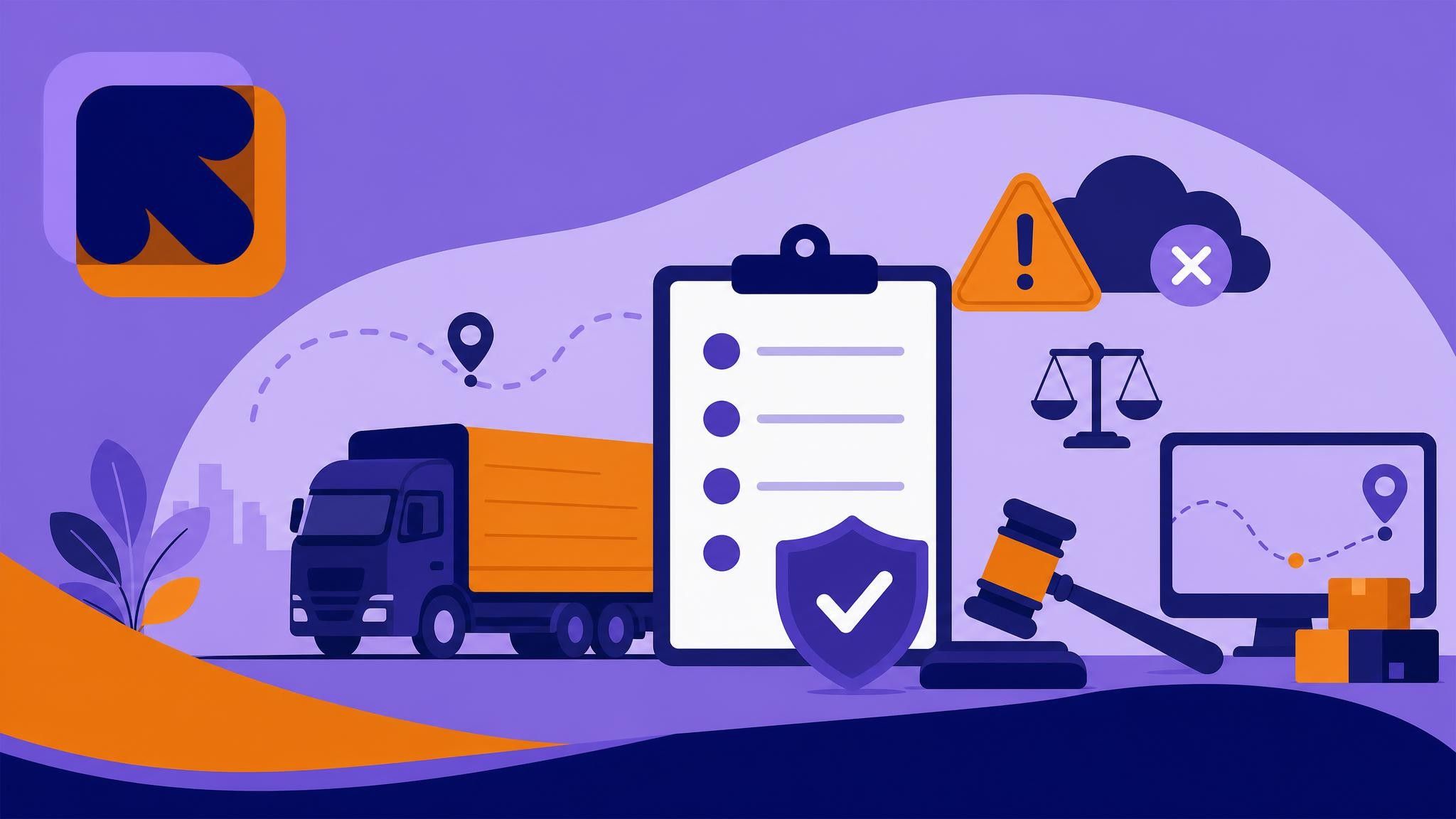
The shipment left the warehouse, the driver is already on the road, and the priority is hitting the delivery window. In the rush, issuing the CT‑e was pushed to later. What can happen? For many carriers and 3PLs, this blind spot is costly. The Conhecimento de Transporte Eletrônico (CT‑e) is the fiscal document that proves the transportation service and underpins ICMS collection. Without it, your company is exposed to fines, cargo holds, and a series of tax and operational risks.
In this article, we explain in practical terms what happens when the CT‑e is not issued, the most common penalties, how this affects your operation, and how to avoid assessments with the right processes and technology — including how Meu Rastreio can simplify day‑to‑day CT‑e issuance.
What the CT‑e is and when it is mandatory
The CT‑e (Conhecimento de Transporte Eletrônico) is the digital fiscal document that formalizes freight services, replacing older paper models. As a rule, it is mandatory whenever there is intercity or interstate freight service subject to ICMS (Brazilian state VAT), across different modes (road, air, rail, water, and pipeline).
Key points:
- Mandatory for carriers providing services to third parties (contracted freight).
- The consignee/shipper (service taker) uses the CT‑e to record freight cost and, when applicable, take ICMS credit.
- Exceptions and specifics can vary by state (UF) and operation type (subcontracting, redirection, annulment, complement, CT‑e OS, etc.).
Practical tip: confirm the specifics of your state and mode with your accounting advisor. The general rule is clear: provided a taxable transport service? Issue the CT‑e.
What happens if the carrier does not issue the CT‑e
Failing to issue the CT‑e is not a “mere administrative delay.” It’s a tax infraction. Tax authorities cross‑check electronic data (NF‑e, MDF‑e, CT‑e, RNTRC, tolls, DI/DU‑E, and even tracking data in some operations) and quickly flag inconsistencies.
Most common penalties
Penalties vary by state (each UF enacts its own ICMS rules), but generally include:
- Fine for lack of issuance: charged as a fixed amount per missing document or as a percentage of the freight or transaction value, per state law.
- Fine for transport without a fiscal document: in addition to the fine, the goods and vehicle can be held until regularization and tax payment.
- ICMS assessment with surcharges: tax due plus penalty and interest.
- Disallowance of credits: the service taker may lose the right to ICMS credit if the CT‑e is missing or irregular.
- Fine for invalid document: when the CT‑e exists but has errors that make it invalid for tax purposes (mismatched data, incorrect tax base, wrong CFOP, etc.).
Important: even if the freight was provided, without the CT‑e the service lacks “fiscal backing” and may be treated as unreported revenue.
Operational and commercial impacts
- Holds at fiscal checkpoints: the vehicle can be stopped and held until the CT‑e is issued and ICMS is paid, causing delays, missed delivery windows, and extra costs.
- SLA breaches and contractual penalties: missed deadlines hurt customer satisfaction and contract profitability.
- Payment blocks: many shippers only process freight payment with a valid CT‑e linked to the NF‑e.
- Reputational risk: recurring non‑compliance drives away high‑value customers and complicates audits with enterprise shippers.
Risks for the shipper (service taker) too
- Joint liability: in several states, the service taker may be jointly liable for ICMS on transport when hiring a provider that fails to issue the proper document.
- Loss of ICMS credit: without a valid CT‑e, credit may be disallowed, increasing the shipper’s tax cost.
Tax enforcement is increasingly electronic and efficient
In recent years, state Departments of Finance (SEFAZ) have advanced automated data matching. Inconsistencies among NF‑e (sale), CT‑e (transport), and MDF‑e (manifest) tend to trigger alerts, raising the likelihood of assessment even without a physical roadside stop.
Frequent CT‑e errors that also trigger assessments
It’s not always about a missing CT‑e. Many assessments stem from common mistakes:
- Data that diverge from the NF‑e: shipper/consignee, license plate, weight, packages, values, or CFOP are inconsistent.
- Wrong rate, CST/CSOSN, or tax base: leads to ICMS underpayment.
- Incorrect operation type: not indicating subcontracting, redirection, annulment/substitution when applicable.
- Late cancellation: each state defines deadlines (many use up to 168 hours, but there are variations). Canceling late may lead to fines.
- Duplicate issuance or out‑of‑sequence numbering: poor control of the electronic numbering range can be fined.
- MDF‑e linkage failures: transporting with an MDF‑e that is not linked to the correct set of CT‑es may be deemed irregular.
Robust checks and systems with preventive tax validations drastically reduce these issues.
How to avoid fines and stay compliant
- Standardize processes: use a pre‑departure checklist and verify NF‑e data, route, and license plates.
- Train the team: operators, billing clerks, and drivers must know when and how to issue the CT‑e.
- Use automatic validations: systems that cross‑check NF‑e data, ICMS rules per state and mode, and flag inconsistencies before SEFAZ authorization.
- Have a contingency plan: know how to proceed if SEFAZ or your connection is down during loading.
- Monitor rejections and deadlines: resolve rejections immediately and control cancellation and event deadlines.
- Store securely: keep XML and the DACTE for at least 5 years, with an audit trail.
- Review periodically with your accountant: align CFOPs, CST/CSOSN, special regimes, and the specifics of your operation.
How Meu Rastreio helps you issue CT‑e safely
Meu Rastreio delivers a complete solution for CT‑e issuance and management, built for hands‑on operations that need speed with tax safety.
Key differentiators:
- CT‑e issuance in minutes: intuitive interface and guided flow reduce typing errors and rework.
- Smart tax validation: updated rules by state and mode, checking CFOP, CST/CSOSN, tax base, and linkage with NF‑e and MDF‑e.
- Preventive alerts and blocks: the system flags critical inconsistencies before submission to SEFAZ.
- Full CT‑e events management: on‑time cancellation, electronic correction letter (CC‑e), and annulment/substitution events when applicable.
- Integrated with your operation: imports order/dispatch data and centralizes information to cut reprocessing.
- Audit and compliance trail: reports of authorized, rejected, and pending documents, with reasons and owners.
- Secure storage for 5 years: automatic XML and DACTE archiving with easy access for inspections and audits.
- Specialized support: onboarding and a team that speaks the logistics operation’s language.
- Multi‑company and multi‑sites: manage multiple taxpayer IDs (CNPJ) and branches with governance and permission controls.
Want to see it in action? Explore Meu Rastreio’s CT‑e issuance module and see how your operation can accelerate while reducing tax risk.
Practical case (hypothetical)
Imagine a regional carrier running daily routes between neighboring cities. During a peak week, three trips left without CT‑e due to manual process gaps. At a fiscal checkpoint, one vehicle was held: the company had to issue the CT‑e on the fly, pay ICMS with surcharges, and cover yard fees, while missing the delivery window — the shipper applied a late‑delivery penalty. When reviewing the month, Finance also found an ICMS credit disallowance by a customer due to document discrepancies.
After adopting Meu Rastreio, the company:
- Standardized the issuance flow and began automatically validating critical data.
- Received inconsistency alerts before vehicles departed.
- Centralized control of cancellation and event deadlines. Result: zero documentation‑related holds for the next three months and a marked drop in debit notes for delays.
Quick FAQs
- Does private (own‑account) transport need CT‑e? For own‑account transport (no service to third parties), CT‑e is generally not issued. However, there are ancillary obligations and MDF‑e rules in specific scenarios. Align with your accounting advisor per state and mode.
- Can I issue the CT‑e after delivery? Issuing outside the ideal flow raises assessment risk, especially if there is enforcement on the route. The correct approach is to authorize the CT‑e before service begins.
- Can errors be corrected? Some formal errors can be fixed via CC‑e; others require cancellation and reissuance within the deadline. Consult your accountant and your state’s rules.
Conclusion: compliance that protects margin and reputation
Not issuing the CT‑e — or issuing it incorrectly — exposes the carrier to fines, holds, credit disallowances, and lost business. With clear processes, a trained team, and a platform that validates tax rules and gives your team visibility, you can dramatically reduce risk and keep operations flowing.
Meu Rastreio helps your company issue CT‑e safely, integrate documents with the MDF‑e, monitor deadlines, and build a complete audit trail — without red tape and without surprises on the road.
Next steps:
- Book a free demo with a specialist and see how Meu Rastreio can simplify your CT‑e issuance and strengthen tax compliance: https://meurastreio.app/pt-BR/cte
- Prefer to talk now? Speak with a specialist and get answers tailored to your operation.