CIOT, CT-e, and MDF-e: what’s the difference and when is each document required?
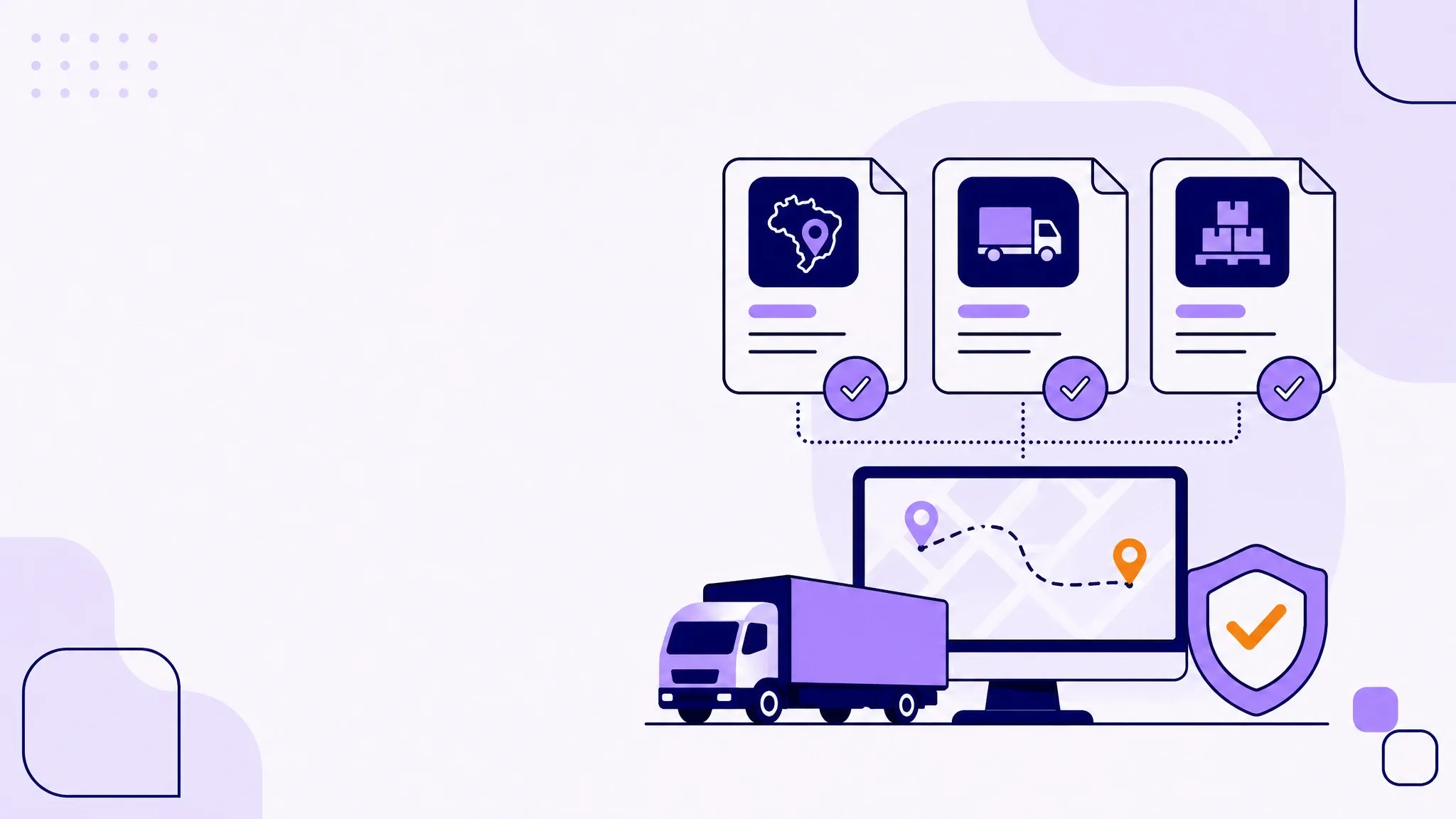
Running road logistics in Brazil demands precise documentation to avoid fines, cargo holds, and operational bottlenecks. Three documents create most of the confusion: CIOT, CT-e, and MDF-e. They are not the same and do not replace each other. Each has a specific purpose, rules, and timing.
In this practical guide, you’ll learn the differences between CIOT, CT-e, and MDF-e, when each is mandatory, and how to organize your processes to gain efficiency and keep operations fully compliant. At the end, see how Meu Rastreio’s CIOT helps your team automate critical steps and reduce day-to-day risk.
Note: Rules may vary by state (UF) and operation type. Use this content as a reference and consult current legislation and your accountant when needed.
What each document is for
CIOT (Código Identificador da Operação de Transporte)
- What it is: a code generated and registered with ANTT (Brazil’s National Land Transport Agency) that identifies the Transport Operation when Electronic Freight Payment (PEF) is made to a TAC (Autonomous Freight Carrier/independent trucker).
- Purpose: ensure transparency and correct freight payment to the TAC per ANTT rules. CIOT is not a tax document; it’s a regulatory requirement for road freight with TAC.
- Who obtains it: the freight contractor (shipper, carrier, cooperative, etc.) when hiring a TAC.
- When: before the trip starts. The CIOT must accompany the operation and be available for inspection.
- Important: CIOT is different from the toll voucher (vale-pedágio). Both may be mandatory but cover different requirements.
CT-e (Conhecimento de Transporte Eletrônico)
- What it is: an electronic fiscal document that records the provision of cargo transportation services. It replaces older paper models and is authorized by the state tax authority (SEFAZ).
- Purpose: formalize service billing and enable correct tax calculation.
- Who issues it: carriers that are ICMS taxpayers (ETC) in operations where freight is charged. CT-e also applies in subcontracting and interline (redespacho) scenarios.
- When: before service starts, with SEFAZ authorization. The DACTE (printed representation) must accompany the cargo in transit.
- Common exception: in own-account transport (no service for third parties), CT-e is typically not issued.
MDF-e (Manifesto Eletrônico de Documentos Fiscais)
- What it is: an electronic document consolidating the fiscal documents that accompany the cargo (CT-e and, in some cases, NF-e).
- Purpose: inform enforcement authorities about the shipment as a whole, route, vehicles, and drivers—especially in road transport.
- Who issues it: generally the carrier for paid transport services. In own-account operations, ICMS taxpayers may need to issue MDF-e when making interstate trips with a company-owned or leased vehicle.
- When: before the trip starts. The DAMDFE (printed representation) must accompany the shipment, and the manifest must be closed at the end of the operation.
Practical differences
- Purpose:
- CIOT: regulatory (ANTT) and tied to Electronic Freight Payment when a TAC is involved.
- CT-e: fiscal (SEFAZ) and tied to the provision of transportation services.
- MDF-e: controls and consolidates cargo and route information during the trip.
- Responsibility:
- CIOT: the party contracting the TAC.
- CT-e: the ICMS-registered carrier providing the service.
- MDF-e: the party responsible for the trip (carrier or, in some cases, the shipper in own-account interstate transport).
- Timing:
- All must be issued/registered and authorized before the trip starts.
- Links between them:
- CIOT links to the freight contract with the TAC and to the PEF.
- CT-e links to the service billing and to the shipper’s NF-e.
- MDF-e consolidates CT-es and, where applicable, NF-es.
When is each one mandatory? Real-world examples (road freight)
- Carrier with own fleet provides a service to a customer
- Scenario: the ETC issues a CT-e to bill the customer for freight.
- Documents:
- CT-e: mandatory.
- MDF-e: mandatory for the trip, especially in interstate operations.
- CIOT: not applicable (no TAC hired; own fleet/employees).
- Carrier hires a TAC (independent trucker) to perform the trip
- Scenario: the ETC provides the service but subcontracts an autonomous driver to execute the trip.
- Documents:
- CT-e: mandatory (the ETC provides the service and issues the CT-e).
- MDF-e: mandatory for the trip.
- CIOT: mandatory, because a TAC is hired and freight is paid via PEF.
- Notes: the CIOT must be obtained before the trip; when applicable, the toll voucher (vale-pedágio) must be provided correctly.
- Shipper hires a carrier and there is interline (redespacho)
- Scenario: the primary carrier issues a CT-e to the shipper and subcontracts another carrier for a leg of the route.
- Documents:
- CT-e: the primary carrier issues a CT-e to the payer; the second carrier may issue a CT-e for subcontracting/interline.
- MDF-e: mandatory for the legs performed.
- CIOT: only if, in any leg, a TAC is hired.
- Own-account transfer between branches using a company vehicle
- Scenario: a manufacturer moves goods between DCs using its own truck.
- Documents:
- CT-e: not applicable (no service provided to third parties).
- MDF-e: may be mandatory, especially if the operation is interstate and the company is an ICMS taxpayer.
- CIOT: not applicable (no TAC hired).
Remember: local details (e.g., city-only operations, tax regimes, or state specifics) may change requirements. Always check your state’s rules and your tax team.
Common mistakes that lead to fines or delays
- Getting the CIOT after the trip has started.
- Reusing a single CIOT for multiple trips.
- Mismatches between CIOT and trip data (amount, origin, destination, license plate, driver).
- Failing to issue or close the MDF-e correctly.
- DACTE/DAMDFE inconsistencies with what’s on the vehicle (plates, trailers, loading state/UF).
- Inconsistent fiscal info across NF-e, CT-e, and MDF-e (weight, volumes, CFOP).
- Lack of proof of Electronic Freight Payment to the TAC in line with ANTT rules.
Standardizing records, organizing processes, and automating validations drastically reduces these risks.
How Meu Rastreio helps you master CIOT CIOT is often the most sensitive link when hiring TACs: strict timelines, ANTT rules, value reconciliation, and audits. Meu Rastreio’s CIOT was built to simplify and bring transparency to this step.
With Meu Rastreio, your team can:
- Generate and manage CIOTs quickly—before the trip starts—in line with current ANTT rules.
- Integrate CIOT with Electronic Freight Payment (PEF) via partners, ensuring traceability of payouts to TACs.
- Standardize trip, vehicle, driver, and route data to reduce discrepancies during inspections.
- Configure non-compliance alerts and blocks (e.g., a trip cannot start without a valid CIOT).
- Centralize history and receipts to streamline audits and accountability.
- Export management reports to track freight costs, TAC performance, and cost centers.
Tangible results:
- Fewer fines and rework.
- Faster trip releases.
- Consistent ANTT compliance.
- Managerial visibility over freight costs paid to independent drivers.
Even if your company handles CT-e and MDF-e in other systems, organizing CIOT in Meu Rastreio closes the compliance loop and reduces blind spots between finance, operations, and legal.
Trends and best practices to keep your operation audit-ready
- Master data standardization: keep TACs, vehicles, and trailers up to date, validating documents and expirations.
- Digital checklists: verify critical data before issuing documents (weight, volumes, plates, loading UF, payer data).
- Freight reconciliation: align CIOT, the contract, and PEF payment proofs.
- Timely MDF-e closure: avoid open manifests that trigger alerts and fines.
- Team training: drivers and yard teams must know which documents to carry and how to act during inspections.
- Monitor regulatory changes: the law evolves—keep processes and systems updated.
Quick checklist: which document do I issue now?
- Will I charge for transport?
- Yes: CT-e is mandatory (and MDF-e for the trip).
- No, it’s own-account cargo: CT-e does not apply; check if MDF-e is required in your state, especially for interstate trips.
- Will an Autonomous Freight Carrier (TAC) be hired?
- Yes: CIOT and Electronic Freight Payment are mandatory.
- No: CIOT does not apply.
- Is the trip about to start?
- All necessary documents (CIOT, CT-e, MDF-e) must be authorized/registered before departure.
Conclusion CIOT, CT-e, and MDF-e play different, complementary roles in logistics operations:
- CIOT ensures compliant freight payment when a TAC is hired.
- CT-e formalizes the service and taxation.
- MDF-e consolidates the trip and streamlines in-transit inspections.
By knowing when to use each, your company reduces risk, speeds up vehicle release, and improves freight cost predictability.
If your operation hires TACs, automating CIOT is crucial to avoid fines and delays. Explore Meu Rastreio’s CIOT and see how to simplify ANTT compliance and boost efficiency in practice: https://meurastreio.app/pt-BR/ciot
Book a free demo to talk to a Meu Rastreio specialist, map your flows, reduce risks, and standardize CIOT across your entire operation.