Transportation management in Brazil demands real-time operational accuracy and fiscal compliance. Amid tight loading windows, dynamic routes, and service-level billing, you must also issue, transmit, and store CT-e, MDF-e, and CIOT without errors. When this is manual, it becomes a bottleneck. When it’s automated inside your TMS, it turns into a competitive edge.
In this article, you’ll learn how a TMS integrated with CT-e, MDF-e, and CIOT eliminates rework, reduces costs, and accelerates your operation—and how Meu Rastreio helps put this into practice with efficiency and security.
What are CT-e, MDF-e, and CIOT—and why integrate them with your TMS
- CT-e (Conhecimento de Transporte Eletrônico): the fiscal document that formalizes freight transportation services. It requires SEFAZ validation, specific tax rules, and event management (cancellation, correction letter, etc.).
- MDF-e (Manifesto Eletrônico de Documentos Fiscais): consolidates documents (such as CT-e and NF-e) that compose the trip and records vehicle, driver, route segments, and states (UF). It must be opened and closed at the right time.
- CIOT (Código Identificador da Operação de Transporte): mandatory ANTT registration when hiring an Independent Truck Driver (TAC), controlling freight payment and regulatory links.
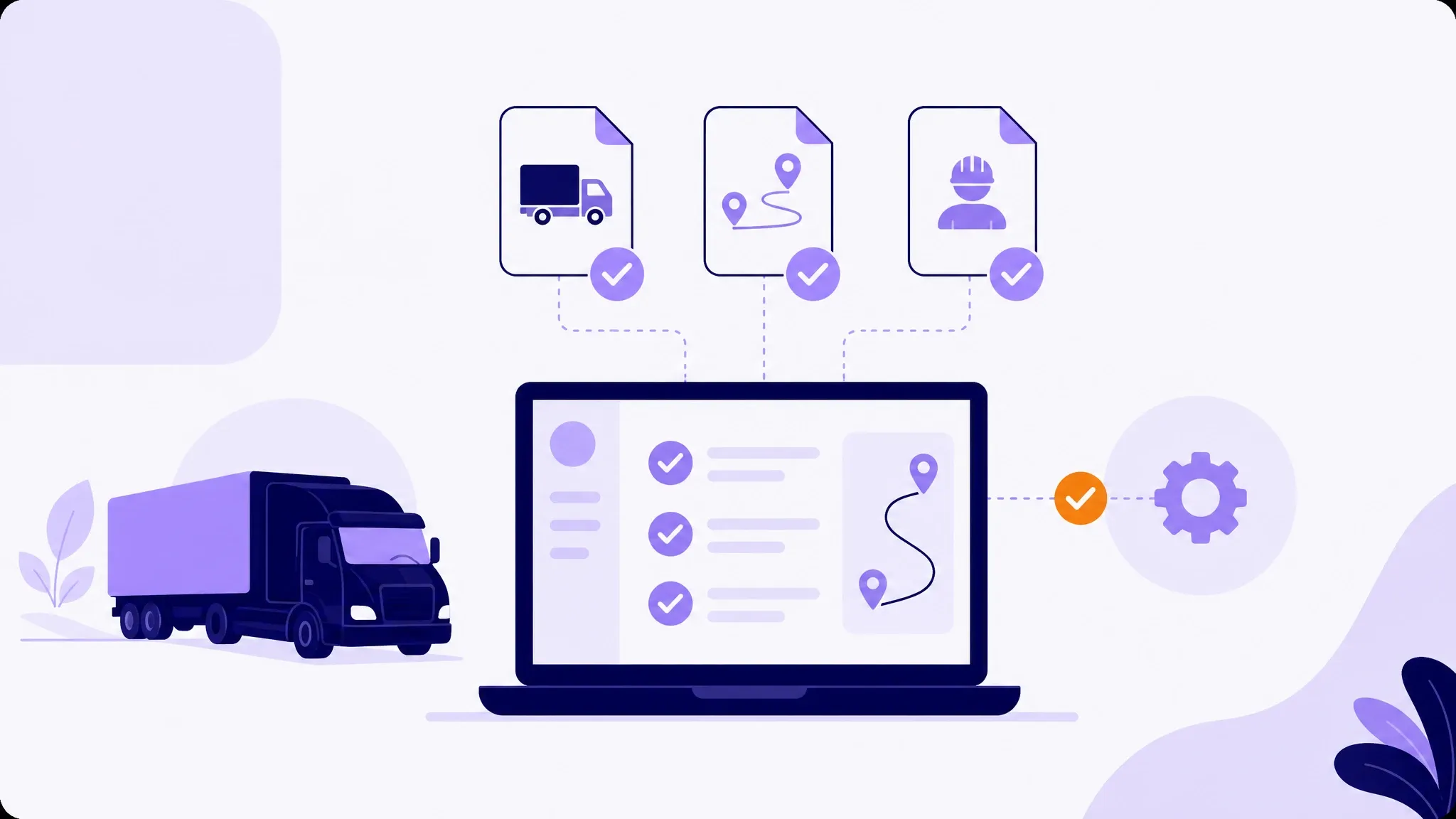
Integrating these documents into your TMS means information flows automatically from the order/load plan to fiscal issuance and trip tracking. The result: less typing, fewer inconsistencies, more speed, and stronger compliance.
Everyday challenges without automation
- Manual data entry and rework: repeated data across ERP, spreadsheets, CT-e emitter, and MDF-e portals.
- Tax errors and outdated records: CFOP, CST, rates, payer data, carrier RNTRC, and license plates.
- Issuance delays: missed pickup windows due to validation issues or SEFAZ transmission failures.
- Fine risk: unclosed MDF-e, missing CIOT when hiring TAC, and inconsistencies between documents.
- Lack of visibility: hard to know who issued what, when, and why a document was rejected.
- Storage and sharing: scattered XMLs; customers and drivers without quick access to what they need.
How a TMS with CT-e, MDF-e, and CIOT automates the end-to-end flow
- Smart pre-validation before issuance
- Configurable tax rules by state (UF), mode, and operation type.
- Registry checks (CNPJ, State Registration, RNTRC), plates, and driver.
- Weight, volume, and CFOP coherence checks aligned to the operation’s nature.
- Preventive alerts that avoid SEFAZ rejections.
- Automatic issuance at the right moment
- CT-e creation from the load order—no duplicate typing.
- MDF-e assembly based on the trip’s CT-es, vehicle/combination, and route states (UF).
- CIOT generation when applicable (TAC hire), with ANTT-compliant registration.
- Toll voucher (vale-pedágio) calculation and recordkeeping, with organized proofs.
- Distribution and access to documents
- Automatic XML and CT-e DANFE delivery to payer, shipper, and consignee.
- MDF-e and QR code available to the driver in the app/portal.
- Secure link sharing to avoid manual messaging exchanges.
- Real-time monitoring and events
- Dashboard with each document’s status (authorized, pending, rejected, canceled).
- Automatic MDF-e closure at trip end based on delivery confirmation.
- Assisted issuance of correction letters and cancellations within legal deadlines.
- Alerts for deadlines and pending items to avoid fines and road inspections issues.
- Audit, KPIs, and compliance
- Full audit trail of who issued, changed, and canceled.
- Indicators: average issuance time, rejection rate, MDF-e closure punctuality, CIOT occurrences.
- Reports for fiscal and financial compliance, supporting internal and external audits.
Tangible, measurable benefits Companies that integrate CT-e, MDF-e, and CIOT into their TMS typically see:
- 50%–80% reduction in issuance time per document.
- Significant drop in rejections due to registry or tax rule errors.
- Fewer fines for unclosed MDF-e and missing CIOT when required.
- Faster billing cycles with quicker CT-e authorization.
- Fewer stops during inspections thanks to consistency and easy document access.
- Higher back-office productivity, freeing hours for analytical work.
Results vary by automation level, document volume, and tax complexity, but ROI usually appears quickly once the process stops being manual.
Real-world automation scenarios Scenario 1: B2B carrier with own fleet
- Before: CT-e issued after pickup; MDF-e opened in the yard; closures forgotten at day’s end.
- After: when scheduling the load in the TMS, the system pre-validates CFOP, shipper, and payer, generates the CT-e, and opens the MDF-e with the planned route. On delivery, confirmation automatically closes the MDF-e. Result: fewer yard delays and zero fines for late closures.
Scenario 2: Operator hiring TAC on seasonal routes
- Before: CIOT generated manually on a portal, with no clear link to the trip. Toll voucher proofs scattered.
- After: when approving a trip with TAC in the TMS, CIOT is registered and linked to the operation, and toll voucher proofs are filed in the same digital trip dossier. Result: guaranteed compliance and faster audits.
Scenario 3: Manufacturer with multiple shippers and interstate routes
- Before: data discrepancies between ERP and fiscal emitter, requiring rework and correction letters.
- After: ERP–TMS integration ensures a single source of truth, with centralized tax tables. Rejections fall, billing accelerates, and the team focuses on high-value exceptions.
Best practices to implement fiscal automation in transportation
- Centralize critical registries: payer, shipper, consignee, vehicles, drivers, and tax parameters.
- Parameterize rules by UF and operation type, including relevant tax exceptions.
- Define clear triggers: when to issue CT-e, when to open/close MDF-e, when to generate CIOT.
- Build a contingency plan: contingency issuance and regularization policies.
- Train the team and drivers: responsibilities, required documents, and app/portal usage.
- Track quality KPIs: rejection rate, issuance time, closure deadlines.
- Review regularly: update tax rules and registries; audit trip samples.
Trends and the future of transport automation
- Document unification and simplification: initiatives to consolidate e-docs and reduce redundancies.
- Digital payments and instant settlement: Pix integrations and freight management solutions with automatic compliance.
- End-to-end traceability: real-time transport events combining TMS, telematics, and digital proof of delivery.
- Data governance: predictive reports to avoid fines and lower costs based on history and patterns.
Companies that prepare now with a robust TMS and automated flows will be ready to adopt new regulatory demands and innovations without friction.
Why choose Meu Rastreio for CT-e, MDF-e, and CIOT
- Unified document flow: issuance and management of CT-e, MDF-e, and CIOT integrated with load scheduling.
- Real-time validations: registry and tax checks before sending to SEFAZ, reducing rejections.
- Rule-based automation: configurable triggers for opening/closing MDF-e and generating CIOT when applicable.
- Driver portal: quick access to CT-e, MDF-e, and trip instructions, with QR code and documents always at hand.
- Alerts and audit: deadline monitoring, complete audit trail, and compliance-ready reports.
- Scalability and security: cloud-native, always up to date, highly available, and LGPD-focused.
- Specialized support: a team that understands transport operations and regulations to support your rollout.
With Meu Rastreio, you reduce operational friction, gain speed in issuance, and stay compliant with fiscal and regulatory requirements—without overloading your team.
Conclusion: turn documents into operational advantage Automating CT-e, MDF-e, and CIOT inside your TMS is not just about “issuing faster.” It creates a frictionless flow from order to trip to billing—with fewer risks and more control. Gains show up in team productivity, fewer fines, faster yard turns, and cash flow.
Ready to see it live in your operation? Book a free demo with a Meu Rastreio specialist and learn how to automate your end-to-end transport operation: https://meurastreio.app/pt-BR/cte