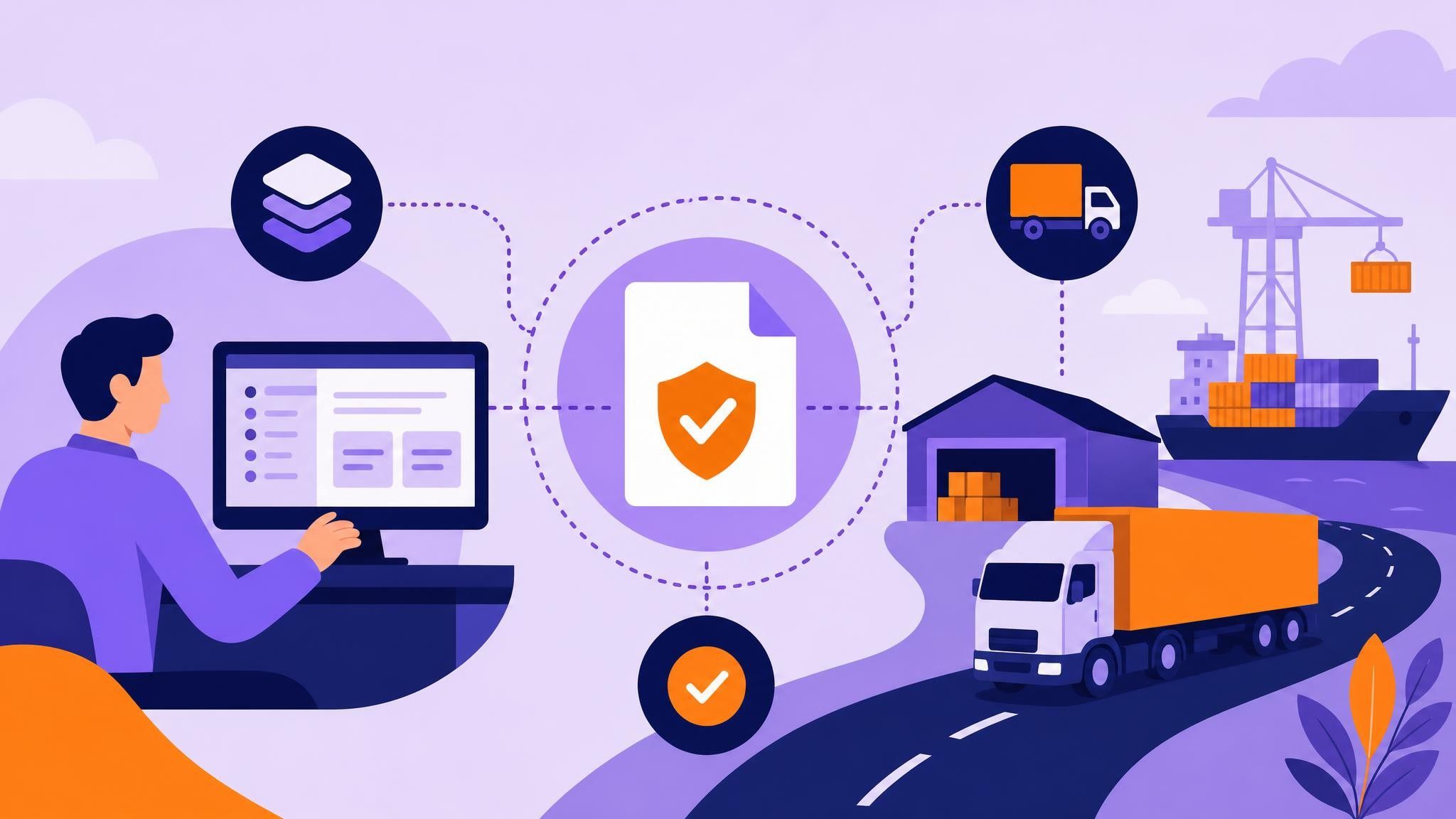
Integrating CIOT issuance with your ERP and operational flow is one of the fastest ways to cut errors, avoid fines, and accelerate gate release. Many companies still treat CIOT as a separate step—outside the ERP/TMS—which creates rework, inconsistent records, and delays at the dock. The good news: with a simple architecture and clear processes, you can turn CIOT into just another automated event in your transportation cycle.
In this guide, you’ll learn how to structure the integration, the practical gains for day-to-day operations, and how Meu Rastreio can simplify the entire process with a ready-to-use CIOT solution.
What is CIOT and why it impacts your ERP and cargo flow CIOT (Transporte Operation Identifier Code) is the official record of freight contracting required by Brazil’s National Land Transport Agency (ANTT) for operations with Independent Truckers (TAC) and TAC-aggregate hired by companies or cooperatives. It ensures transparency in contracting and paying freight via authorized financial institutions and must align with fiscal documents such as CT-e.
In practice:
- CIOT requires precise operational data (shipper, carrier/driver, vehicle, origin/destination, amounts, and payment method).
- It must be available for inspection and remain consistent with CT-e and supporting tax documents.
- Without integration, issuance becomes a bottleneck: duplicated data, inconsistencies, and loss of traceability across ERP, TMS, and the freight payment method.
By integrating CIOT with your ERP, you turn the record into a native part of your transportation flow: the system triggers issuance at the right time, runs validations, receives the CIOT number, and keeps everything auditable—no spreadsheets or parallel typing.
Common challenges when CIOT isn’t integrated
- Duplicate records: driver, RNTRC (National Registry of Road Cargo Transporters), and vehicle data diverge across ERP, TMS, and the CIOT provider.
- Operational rework: manual typing and repeated checks increase time per trip.
- Errors and rejections: nonconformities (expired RNTRC, inconsistent CPF/CNPJ) surface only at loading time.
- Yard delays: late issuance blocks truck release, hurts SLAs, and misses time windows.
- Low visibility: hard to reconcile CIOT, CT-e, advances, and freight balance for audit and compliance.
- Poor driver experience: lack of clear communication on advances, toll vouchers, and proof of issuance.
How to plan CIOT integration with ERP and TMS
- Map the critical data in the ERP Define the master fields that will feed the issuance:
- Shipper and contracted party (CNPJ/CPF, RNTRC, contractor type).
- Driver and vehicle (license plate, CPF, RNTRC, ANTT equipment ID when applicable).
- Operational details (origin/destination, cargo type, planned pickup/delivery, route).
- Values and conditions (freight, advance, balance, toll voucher, payment method).
- Linked documents (order, loading order, MDF-e/CT-e). Standardizing records (masks, CNPJ/CPF/plate validation) prevents rejections.
- Define operational triggers Issuance should happen automatically at a clear point in the flow. Common examples:
- Releasing the loading order in the ERP/TMS.
- Validating vehicle and driver checklist.
- Issuing the CT-e (when immediate linkage is required). The key is to trigger after pre-validations and before the vehicle reaches the gate.
- Establish automatic validations Implement checks that hold the flow until everything complies:
- Query/validate RNTRC and driver status.
- Consistency between freight values, advances, and payment method.
- Check vehicle–driver linkage (when required).
- Enforce minimum mandatory registration rules.
- Orchestrate the CIOT callback When the CIOT number returns, it should:
- Automatically update ERP/TMS records.
- Link to CT-e and trip documents.
- Trigger notifications to yard and driver (app, SMS, or email) with boarding instructions.
- Feed reports and an audit trail.
- Handle exceptions and cancellations Define clear flows for:
- Reissuance due to registration errors or vehicle/driver changes.
- Cancellation for aborted loads.
- Contingency (how to proceed if the provider is temporarily unavailable).
- Legal timelines and data retention policies under applicable regulations.
Recommended flow: from order to freight payment
- Load scheduling in ERP/TMS: create the trip and link it to the freight contract.
- Automatic pre-validations: RNTRC, CPF/CNPJ, plate, route data, and values.
- Issuance trigger: upon releasing the loading order, the system sends data for CIOT issuance.
- Callback and recording: the CIOT number is stored on documents and shown on the operational dashboard.
- Driver communication: send CIOT proof and conditions for advances and balance.
- Adjustments and reissuance: if vehicle/driver changes, the system guides the correct procedure.
- Settlement and reconciliation: integrate with the freight payment method to settle advances, balance, and toll vouchers.
- Audit and KPIs: compliance reports, issuance times, rejection reasons, and costs.
Best practices for compliance and efficiency
- Single source of truth: centralize and standardize driver, vehicle, and contractor master data in the ERP.
- Smart block rule: don’t release the dock/gate without a valid CIOT (when applicable).
- Compliance dashboard: flag trips with registration or validation issues before the pickup window.
- Governance and data privacy: access control, change history, and secure storage of documents and logs.
- Exception handling: playbooks for driver swaps, route changes, re-deliveries, and returns.
- Key performance indicators (KPIs):
- Average issuance time per trip.
- Rejection rate by reason (registration, RNTRC, values).
- Percentage of trips with automatic issuance.
- Impact on pickup/delivery SLAs and yard time.
Use cases and practical gains
-
Shipper with high volume and tight windows:
- Before: manual issuance at the counter; trucks waiting for release; missed windows.
- After: CIOT issued automatically when the load order is released; drivers arrive at the gate with everything validated. Result: shorter queues, better punctuality, and fewer idle hours.
-
Carrier with multiple branches:
- Before: divergent data by branch, high rejection rates, and accounting rework.
- After: centralized master data, unified validation rules, and branch-level audit trail. Result: standardization and corporate control with consolidated reports.
-
Seasonal operation:
- Before: temporary staff unfamiliar with the process, leading to more errors.
- After: guided workflows and automatic validations. Result: faster ramp-up and lower nonconformity risk during peaks.
Trends to watch next
- End-to-end compliance automation: from pre-validations to issuance, reconciliation, and audit in a single flow.
- Integration with freight and toll voucher payment platforms: less friction from contracting to advances and settlement.
- Real-time orchestration: operational events triggering compliance actions without human intervention.
- Executive dashboards: unified view of costs, timelines, risk, and compliance.
How Meu Rastreio simplifies CIOT integration Meu Rastreio is designed to put CIOT at the center of your logistics flow—without technical friction and with a focus on operational results. With Meu Rastreio’s CIOT solution, you can:
- Automate CIOT issuance from ERP/TMS events, reducing manual input and rework.
- Apply upfront validations for registration, RNTRC, and business rules before load release.
- Centralize monitoring in a single dashboard with alerts for pending items and trip status.
- Link CIOT to operational documents (such as CT-e) and maintain an accessible audit trail.
- Integrate with freight and toll voucher payment methods to streamline advances and balances.
- Measure and improve continuously with compliance and efficiency KPIs.
Want to see it in action? Explore the solution: https://meurastreio.app/pt-BR/ciot
30-day implementation checklist
- Week 1 — Discovery and flow design:
- Map fields and triggers in the ERP/TMS.
- Define mandatory validations and exception handling.
- Week 2 — Integration and testing:
- Connect systems; test typical scenarios and rejections.
- Validate audit trail and access control.
- Week 3 — Pilot and training:
- Run a pilot at one site/branch or product line.
- Train operators, yard team, and billing.
- Week 4 — Go-live and continuous improvement:
- Roll out to remaining operations.
- Monitor KPIs and fine-tune validation rules.
Conclusion: turn CIOT integration into a competitive edge Integrating CIOT issuance into your ERP and logistics operation moves the task from the fringes to the heart of the process—with fewer errors, more speed, and full traceability. The results are tangible: faster load release, a better driver experience, and legal peace of mind for your company.
Meu Rastreio helps you get there with a modern, secure, results-driven solution, ready to connect to your ERP/TMS and automate compliance without friction.
Book a free demo and take your operation to the next level: https://meurastreio.app/pt-BR/ciot