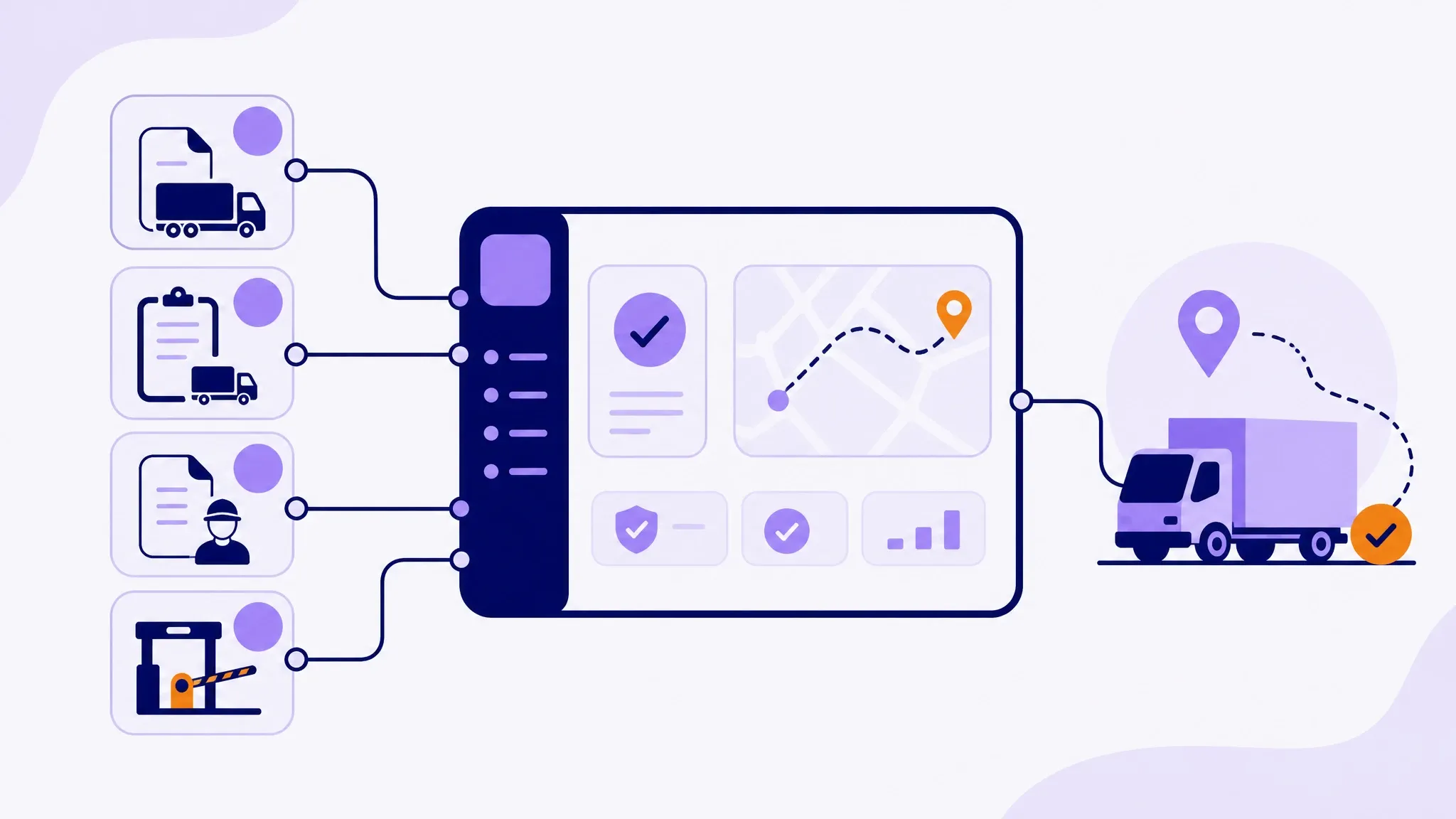
Issuing and controlling Brazil’s electronic transport tax documents — CT-e, MDF-e, CIOT, and Vale-Pedágio — are core to compliance and operational efficiency. When each one lives in separate systems, spreadsheets, and portals, bottlenecks appear: rework, missed deadlines, inconsistencies, and the risk of fines. For fleet managers, logistics operators, and back-office teams, the question isn’t whether to centralize, but how to do it without slowing the operation.
This article shows how a compliance-focused TMS unifies the entire issuance and audit journey — from CT-e to MDF-e, from CIOT to Vale-Pedágio — delivering standardization, control, and speed. You’ll also see how Meu Rastreio’s Fiscal helps you achieve this securely and at scale.
The road-transport compliance “alphabet”
CT-e (Conhecimento de Transporte Eletrônico) Formalizes the transport service. It supports ICMS calculation, sets responsibilities (shipper, consignee, payer), and backs freight billing. Accurate CT-e issuance — with CFOP, CST, cargo data, and amounts aligned — directly impacts checkpoint clearance and your company’s fiscal health.
When it’s crucial:
- Intercity and interstate moves
- Subcontracting, reshipment, and intermediate reshipment
- Transfers between branches using own transport (when permitted by law)
MDF-e (Manifesto Eletrônico de Documentos Fiscais) Consolidates the trip’s documents (CT-es and/or NF-es) into a single manifesto per vehicle/combination. MDF-e aligns origin/destination, supports route inspections, and gives visibility into cargo movement. Without a valid MDF-e, the risk of retention and penalties increases.
CIOT (Código Identificador da Operação de Transporte) Mandatory when hiring an owner-operator (TAC) or equivalent. CIOT formalizes the freight and ensures payment via an authorized electronic freight payment (EFP) provider. Proper CIOT management avoids fines and blocks while adding traceability to freight payments.
Vale-Pedágio Obrigatório (Mandatory Toll Voucher) Must be prepaid to the carrier (TAC or company) and proven separately from the freight value. Noncompliance leads to penalties. Correct per-axle/route calculation, prepayment proof, and easy access to documents are key to compliance.
Operational challenges that slow you down
- Multiple portals and spreadsheets: CT-e in one system, MDF-e in another, CIOT in EFP platforms, and Vale-Pedágio with a separate vendor — multiplying logins, data versions, and failure points.
- Master-data and rules errors: wrong CFOP, expired RNTRC, license plate incompatible with cargo, weight mismatch between CT-e and MDF-e, outdated payer records.
- Tight timelines and windows: late issuance, unhandled contingencies, cancellations outside the deadline, and misuse of correction letters.
- Low visibility: hard to answer basic questions — how many CT-es were rejected today? Which trips lack CIOT? Where is Vale-Pedágio proof missing?
- Regulatory and financial risk: fines, checkpoint holds, delivery delays, extra yard costs, and lower end-customer satisfaction.
Why centralize everything in one TMS
- Standardized rules: a single validation engine prevents document mismatches, ensures correct fields, and reduces SEFAZ rejections.
- End-to-end visibility: from freight creation to toll-voucher proof, everything is traceable on a single timeline with KPIs and operational alerts.
- Less rework: batch issuance, data reuse, validated records, and automated events (MDF-e closure, number voiding, etc.).
- Built-in compliance: CIOT generated at the right moment; Vale-Pedágio calculated and proven; all attachments and XMLs organized for internal and external audits.
- Scalability: more trips with the same team, less dependence on mega-spreadsheets, and less tacit knowledge concentrated in a few people.
- Finance integration: reconciliation of freight, tolls, and advances integrated with billing and accounting to simplify month-end.
How Meu Rastreio Fiscal unifies your operation
Meu Rastreio’s Fiscal (https://meurastreio.app/pt-BR/cte) puts transport tax management at the heart of the TMS, with performance and compliance by design.
Key capabilities:
-
CT-e and MDF-e issuance with real-time validations
- Pre-validations for CFOP, CST, NCM, vehicle data, weight/volume, and payers
- Rules by state (UF), operation type (own fleet, subcontracting, reshipment), and tax profile
- Automatic XML and PDF generation and storage
-
CIOT management embedded in the trip flow
- CIOT issuance at the right process step to prevent trips without a code
- Centralized registry and queries, with alerts for pending items
-
Vale-Pedágio under control
- Per-route and per-axle calculation with configurable parameters
- Prepayment proof linked to the trip and tax documents
- Reports for audits and account reconciliation
-
Audit trail and compliance history
- Full per-trip/document log with timestamps
- Dashboards for rejections, contingencies, cancellations, and MDF-e closures
- KPIs such as rejection rate, average issuance time, and trips with pending items
-
Multi-origin and multi-company operation
- Import data from multiple ERPs, spreadsheets, and operational modules
- CNPJ/branches, user profiles, and granular permissions by role (tax, operations, finance)
-
Productivity and governance
- Batch issuance, client/route templates, configurable required fields
- Proactive alerts (RNTRC expiring, CIOT pending, MDF-e to close)
- Central hub for documents during inspections and internal audits
All this in an interface that’s easy for operators and powerful for tax specialists.
Practical, measurable benefits
- Fewer rejections and contingencies: early validations cut rework and increase first-pass acceptance.
- Faster issuance: field automation, templates, and data reuse shorten the cycle from planning a trip to releasing the truck.
- Sustained compliance: CIOT and Vale-Pedágio handled as part of the process, not parallel “to-dos” prone to being forgotten.
- Lower operating cost: fewer correction hours, fewer call-backs, and fewer issues at tax checkpoints.
- Scalability: support growth in volume without firefighting every demand spike.
A real-world flow: from order to road without bottlenecks
Imagine a 20-vehicle operation running interstate routes daily:
- The order becomes a transport job in the TMS with customer and cargo data.
- Meu Rastreio Fiscal automatically validates CFOP, tax setup, and payer master data.
- CT-e is issued and approved; MDF-e is generated consolidating documents and the planned route.
- One trip hires a TAC. The system issues the CIOT in-flow, linked to the CT-e and MDF-e.
- Vale-Pedágio is calculated and prepaid, with proof attached to the trip.
- Alerts remind teams to close the MDF-e at the end of the route, avoiding pending items.
- All XMLs, proofs, and reports are ready for audit and financial reconciliation.
Result: fewer inspection stops, aligned documents, and a team focused on what matters — on-time, high-quality service.
Best practices to roll out tax centralization in your TMS
- Map current processes
- Document how each item is issued today, known exceptions, and where errors or rejections occur most.
- Standardize master data
- Update customers, drivers, vehicles, RNTRC, CFOPs, and operation types.
- Define rules and roles
- Who can issue, cancel, correct? Which fields are mandatory by operation type?
- Pilot, then scale
- Start with a subset of routes/customers, validate KPIs (issuance time, rejection rate), and scale in waves.
- Train and measure
- Provide training paths, monitor KPIs weekly, and tune rules as you learn.
Trends and insights for 2025 and beyond
- Smarter validations: systems prevent errors before they happen, based on history and rejection patterns.
- Provider consolidation: fewer platforms, more governance. Centralizing in the TMS reduces interfaces and simplifies compliance.
- Data as an advantage: rejection, issuance-time, and toll-cost KPIs guiding negotiations, routing, and budgeting.
- More digital oversight: audits requiring XMLs, trails, and proofs accessible on demand — a differentiator for organized operations.
Conclusion: centralization equals efficiency, safety, and scale
CT-e, MDF-e, CIOT, and Vale-Pedágio are more than obligations — they’re productivity levers when integrated in a TMS. By centralizing, you reduce risk, accelerate operations, and build a solid foundation for growth.
Meu Rastreio Fiscal unifies issuance, validation, audit, and proof in a single flow — with governance and day-to-day simplicity.
Want to see how this works in your operation? Book a free demo of Meu Rastreio Fiscal and talk to a specialist: https://meurastreio.app/pt-BR/cte